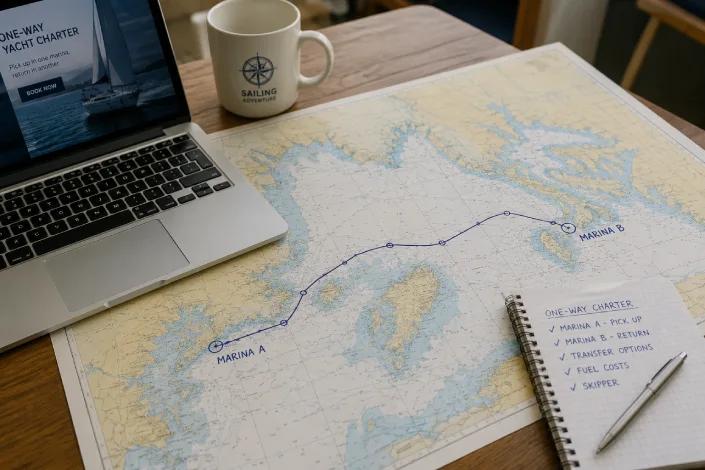
A one-way yacht charter or one-way boat rental, is a type of charter where you collect the vessel in one marina and return it to a different one. At first glance, this may seem like a small difference compared to a standard charter, but from our experience, this option often completely changes the way guests plan their sailing holiday.
Over the years, we have worked with many guests who wanted to explore as much coastline as possible during a one-week or two-week cruise. That is exactly why we often recommend a one-way charter when the itinerary naturally leads from one region to another and there is little benefit in retracing the same route. More coastline. More islands. More new places. Without spending the final days of your sailing trip returning to the departure marina.
Why Do Guests Choose a One-Way Charter?
The biggest advantage of this type of yacht rental is a more varied itinerary. Instead of sailing in a circle, you can continue discovering new destinations day after day. We have noticed that our guests especially appreciate this style of cruising on longer routes where returning to the starting port would require several additional days of sailing or motoring.
A one-way charter is particularly practical for guests arriving by air or using ferry connections. In such cases, it is possible to choose one port for arrival and another for departure, which often makes travel arrangements much simpler. Guests arriving by car should, however, think in advance about how they will return to the vehicle left at the departure marina.
Fortunately, there are solutions for that as well. We can help arrange transfers between marinas, while many guests use rental cars or public transportation. In reality, these situations are usually much easier to solve than most people initially expect.
Can All Boats Be Chartered This Way?
No, they cannot. And this is one of the most important things to understand before planning your trip.
From our experience, the availability of a one-way charter depends not only on the vessel itself but also on the charter company's operational structure. Some companies have two or more charter bases from which they regularly rent boats, making this type of arrangement relatively straightforward. In these cases, there is already a berth available for the returning yacht, staff to perform the final inspection and all resources necessary for a proper handover procedure.
For this reason, the departure and return marinas are most often located within the existing base network of the same charter company. These arrangements are usually the simplest, most cost-effective and least risky for everyone involved.
What If the Charter Company Has No Base in the Desired Return Port?
In that situation, things become a little more complicated. When a vessel is returned to a marina where the charter company has no operating base, it becomes necessary to organise personnel who will carry out the final yacht inspection and return procedure.
This also includes checks that are not immediately visible. For example, the underwater section of the hull is often inspected by a diver to determine whether any damage exists below the waterline. Only after all inspections have been completed can the security deposit be released, assuming the boat has been returned in good condition.
We have observed that charter companies frequently cooperate with another operator that already has a base in the desired return marina. Their staff can then perform the check-in process and vessel handover on behalf of the owner or management company.
If guests wish to leave the boat in a location where no charter base exists and cooperation with another operator is not available, temporary staff may need to be hired to perform inspections and handle the administrative aspects of the return. Nothing is impossible. However, the potential for complications increases, and with it, the overall charter cost generally rises as well.
Why Is a One-Way Charter More Expensive?
This is one of the questions we receive most often.
The additional one-way fee usually covers the cost of a skipper who must return the yacht to its home base, along with the fuel required for that transfer. In many cases, these two expenses represent the largest part of the one-way surcharge.
There is another important factor. Time.
To ensure the vessel is ready for the next group of guests who booked under standard charter conditions, the charter period often needs to end one day earlier. This gives the skipper sufficient time to return the yacht to the departure base, where the next crew is waiting. In practice, this means guests may sometimes use the boat for one day less, which can also affect the overall value of such an arrangement.
Because of possible weather disruptions and the risk of not returning the vessel to its home base on time, some charter companies are not particularly enthusiastic about offering one-way rentals. We can confidently say that the logistics involved in a one-way charter are significantly more demanding than those of a traditional round-trip sailing holiday.
From our experience, the entire process becomes much easier when a professional skipper is hired for the full charter period. In that case, once the guests disembark, the skipper takes responsibility for the vessel, returns it to its home marina and completes the final handover with the charter company representatives.

Are There Situations Where a One-Way Charter Is Almost Free?
Yes, and such situations are not uncommon.
Sometimes a charter company already has another group of guests scheduled to take over the yacht in exactly the marina where the previous crew intends to leave it. If the new guests return the vessel to its original base after their cruise, the need for an additional relocation transfer practically disappears.
We have also seen cases where charter companies offered special discounts because guests agreed to a predetermined departure marina and a different return location. In these situations, the one-way fee may become very small or disappear entirely, and occasionally an additional discount on the regular charter price is also available.
How Does a One-Way Cabin Charter Work?
With cabin charters, the situation is slightly different. Since the vessel follows a predefined itinerary, guests often embark and disembark in different ports.
For example, a guest may reserve a specific cabin in advance and arrange to board in one intermediate port and leave the vessel in another. After that, a new passenger can occupy the same cabin. This style of travel is very common on organised cruises and provides considerable flexibility without the need to charter an entire yacht.
Our Advice Before Booking
We always recommend that the availability of a one-way charter is carefully confirmed before making final travel arrangements or purchasing airline tickets. Not every vessel is available for this type of charter, and not every desired route can be organised without significant additional costs.
If you are considering this type of sailing holiday, we suggest that you send us an enquiry as early as possible. From our experience, the best solutions are usually found when there is enough time for coordination between marinas, charter companies and any partners involved in organising the vessel's return.
And when everything is arranged properly? A one-way yacht charter can become one of the most memorable sailing experiences you will ever enjoy. One route. Two ports. Far more coastline to discover.