What does the structure of Croatia’s charter fleet look like by yacht age at the end of the 2026 season? We analyzed data for a total of 3,812 vessels – 2,370 sailboats, 884 catamarans and 558 motorboats – to get an idea of how much the current market offering has actually been renewed.
Unlike estimates that are commonly used in analyses, the structure here was calculated based on the actual number of boats and their years of production in the observed sample, providing a more precise insight into the structure of Croatia’s charter fleet.
More than 80% of yachts are less than 10 years old
When all three types of vessels (sailboats, catamarans and motorboats) are considered together, the average age of the fleet is 6.6 years.
The youngest group consists of boats produced between 2022 and 2026. There are 1,619 of them, or 42.5% of the entire sample of charter boats in Croatia.
Another 1,432 vessels, or 37.6%, were produced between 2017 and 2021.
This means that a total of 80.0% of the observed yachts are less than 10 years old i.e. were produced between 2017 and 2026.
By contrast, only 2.9% of the fleet dates from 2006 or earlier.
Share of charter yachts by year of production
|
Year |
Sailboats |
Catamarans |
Motorboats |
Total |
|
≤ 2014 |
10.89% |
1.07% |
1.39% |
13.35% |
|
2015 |
2.57% |
0.39% |
0.31% |
3.28% |
|
2016 |
3.28% |
0.39% |
0.16% |
3.83% |
|
2017 |
5.80% |
1.10% |
0.81% |
7.71% |
|
2018 |
6.64% |
1.49% |
0.73% |
8.87% |
|
2019 |
5.67% |
2.44% |
0.76% |
8.87% |
|
2020 |
4.25% |
2.10% |
0.84% |
7.19% |
|
2021 |
2.34% |
1.63% |
0.97% |
4.93% |
|
2022 |
3.83% |
2.07% |
1.31% |
7.21% |
|
2023 |
★ 6.61% |
3.17% |
2.13% |
11.91% |
|
2024 |
★ 7.16% |
3.60% |
1.84% |
12.59% |
|
2025 |
3.36% |
2.26% |
1.26% |
6.87% |
|
2026 |
1.39% |
1.73% |
0.76% |
3.88% |
|
TOTAL |
62.17% |
23.19% |
14.64% |
100.00% |
Catamarans are by far the youngest segment
The biggest difference can be seen among catamarans.
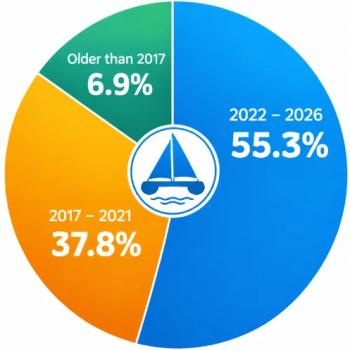
Their average age is only 4.6 years, and as many as 55.3% of all charter catamarans in Croatia in the observed sample were produced between 2022 and 2026.
Another 37.8% of catamarans belong to the 2017–2021 production years, meaning that as much as 93.1% of catamarans come from the 2017–2026 period. In other words, only a small part of the catamaran fleet consists of boats more than around ten years old.
There are very few older catamarans: only 0.9% were produced between 2007 and 2011, while 0.2% date from 2006 or earlier. This shows how strongly the catamaran segment has been renewed in recent years and how many new catamarans for rent have entered Croatia’s charter offering.
Sailboats: a large fleet, but still relatively young
The picture is somewhat different for sailboats. Their average age is 7.2 years.
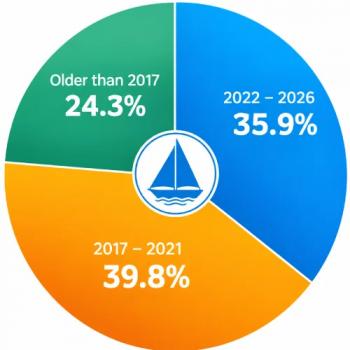
The largest individual group consists of sailboats produced between 2017 and 2021, accounting for 39.8% of all Croatian charter sailboats in the observed sample, while 36.0% were produced between 2022 and 2026.
In total, 75.7% of sailboats are less than 10 years old, i.e. belong to the 2017–2026 production years.
Only 2.8% of the sailboats in the sample were produced in 2006 or earlier.
This means that more than three quarters of the analyzed sailboats were produced within the last ten years, while older boats make up a relatively small part of the offering.
Motorboats show the greatest diversity in age
Motorboats have an average age of 7.3 years, very similar to sailboats, but their age structure is somewhat more diverse.
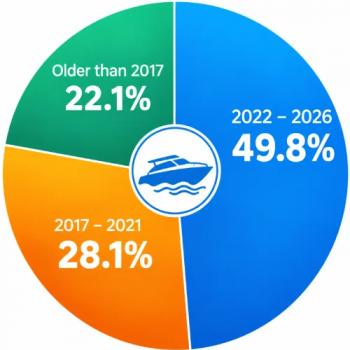
Almost half of motorboats for charter in Croatia, or 49.8%, were produced between 2022 and 2026, while another 28.1% come from the 2017–2021 period.
On the other hand, motorboats also have the highest share of older production years: 7.2% of boats were produced in 2006 or earlier.
What does the age of the fleet tell us about the future of Croatia’s charter market?
The data shows that Croatia’s charter offering at the end of the 2026 season is not dominated by older boats. On the contrary, four out of every five observed boats were produced during the last ten years.
|
Type |
Number of boats in sample |
Average age |
2017–2021 |
2022–2026 |
|
Sailboats |
2,370 |
7.2 yrs. |
39.8% |
35.9% |
|
Catamarans |
884 |
4.6 yrs. |
37.8% |
55.3% |
|
Motorboats |
558 |
7.3 yrs. |
28.1% |
49.8% |
The data shows an interesting difference between the segments. Catamarans are by far the youngest part of Croatia’s charter fleet, while sailboats have a somewhat broader age structure. Motorboats fall between the two segments in terms of average age, but have the widest age range.
The production-year structure shows that Croatia’s charter market is not predominantly reliant on older yachts. On the contrary, a large part of the offering consists of boats produced in the last few years, and this trend is particularly visible among catamarans.
Renewal of Croatia’s charter fleet is slowing
Although we do not have historical data showing how many boats entered and left Croatia’s charter fleet in each year, the structure of the current fleet nevertheless clearly reveals a pattern of fleet renewal.
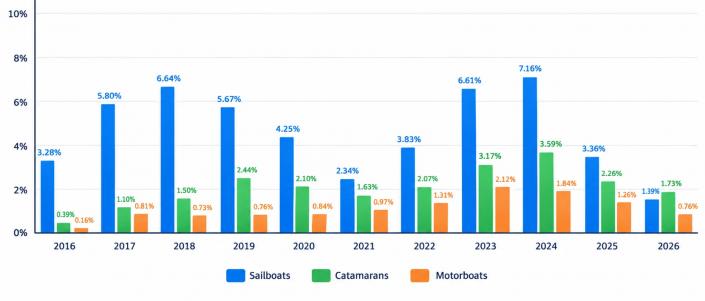
The share of yachts produced in 2023 and 2024 is particularly high: these two production years together account for 24.50% of the total observed fleet, with 2024 representing the largest individual annual share at 12.59%. This is a strong indication of a period of intensive investment in new yachts and expansion of rental capacity. After that, the share drops sharply to 6.87% for 2025 production and to just 3.88% for 2026 production. In other words, the current fleet structure shows that the largest wave of newer boats entering the charter market clearly occurred around 2023 and 2024, while fleet renewal has slowed considerably over the last two years.
Such a development may also point to a broader change in the relationship between supply and demand. After a period of strong investment in new rental boats, the market appears to have started slowing down and adjusting the amount of available capacity. The smaller share of vessels from 2025 and particularly 2026 does not necessarily mean only that owners have become more cautious; it may also be the result of lower demand, greater existing supply and the need for the market to rebalance. Of course, without data on vessels leaving the charter fleet each year, we cannot determine the actual number of new boats entering charter. However, the structure of the current fleet very clearly indicates a slowdown in the renewal cycle following the peak of 2023–2024.
Are we entering a new phase of Croatia’s charter market after the fleet renewal wave?
Croatia’s charter fleet in 2026 is relatively young, with an average age of 6.6 years and 80% of yachts produced between 2017 and 2026.
A high share of new boats represents a competitive advantage for the Croatian market, but at the same time increases competition among operators and may limit room for rental price growth if demand does not keep pace with the increase in supply.
After the strong wave of investment in new yachts during 2023 and 2024, the fleet structure shows a slowdown in renewal and a more cautious entry of new capacity into the market.
In the future, occupancy, price management, service quality and efficient use of the existing fleet will therefore play a more important role than simply increasing the number of yachts.
For investors, charter operators and policymakers, maintaining a balance between supply and demand will be crucial to ensure sustainable market growth, competitive prices and the long-term profitability of investments.
These data also raise an interesting question for further analysis: how does the age of the charter fleet differ between the main Mediterranean markets and is there a connection between fleet structure, average charter prices and occupancy?
Author: Ani Trstenjak, PhD

ACKNOWLEDGEMENT: This work was fully supported by the University of Rijeka project UNIRI-IZ-25-260 “THREE DIMENSIONS OF TOURISM SUSTAINABILITY”.