Current data for 2026 covering the operational charter season reveals significant differences in prices, occupancy and revenue potential across the Mediterranean. The most expensive market is not necessarily the most profitable — and some of the most heavily booked fleets may be leaving revenue on the table.
The latest analysis of sailboat and catamaran charter prices and bookings in Croatia, Greece, Italy, Turkey, France and Spain reveals a Mediterranean market with very different pricing strategies.
Unlike analyses based on estimates or approximate price and occupancy ranges, this analysis uses real data from thousands of boats in our database, with precisely calculated weekly prices and weekly occupancy. The values presented in the analysis are not approximate “from–to” estimates, but mathematically calculated averages based on real data, providing a realistic insight into the state of the charter market.
The data covers the operational season from April 1 to November 2, 2026, deliberately excluding the winter period, when a large part of the Mediterranean charter fleet is not available on the market. This significantly reduces the impact of statistical distortions and focuses the comparison on the period when charter companies actually operate their fleets.
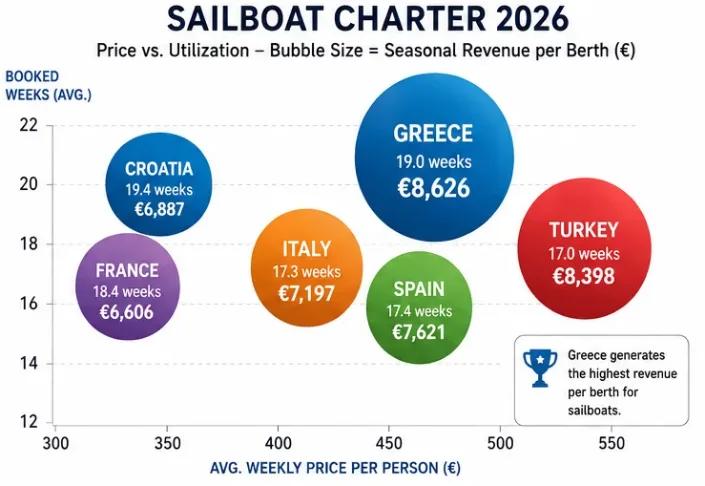
One of the clearest conclusions is that Greece currently has the best combination of price and utilization, generating the highest estimated seasonal charter revenue per available berth for both sailboats and catamarans.
But Greece is not the most expensive market.
Greece turns high occupancy into the highest revenue
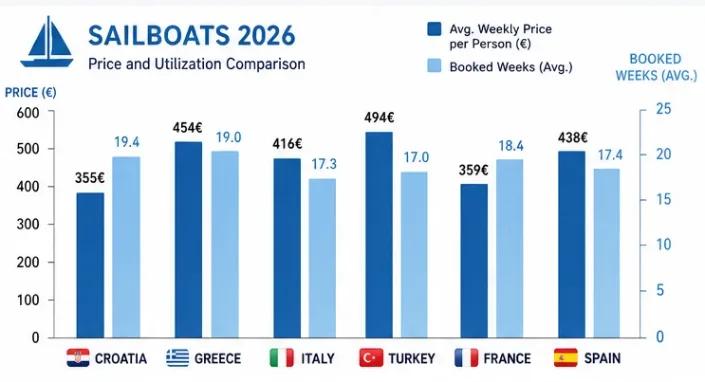
Among sailboats, Turkey currently achieves the highest average price at €494 per person per week.
However, Greece generates higher seasonal revenue.
Greek sailboats achieve an average price of €454 per person per week and are booked for approximately 19 weeks during the operational season. This results in an estimated gross seasonal revenue of €8,626 per available berth.
Turkey charges an average of 9% more than Greece, but its sailboats are booked for only 17 weeks, resulting in revenue of €8,398 per berth.
The difference is small — but it demonstrates how important it is to look at price together with occupancy, rather than considering either of these indicators separately.
Sailboat charter in 2026
|
Country |
Avg. weekly price / person |
Booked weeks |
Seasonal revenue / berth |
|
★ Greece |
€454 |
19.0 |
€8,626 ★ |
|
Turkey |
€494 ★ |
17.0 |
€8,398 |
|
Spain |
€438 |
17.4 |
€7,621 |
|
Italy |
€416 |
17.3 |
€7,197 |
|
Croatia |
€355 |
19.4 ★ |
€6,887 |
|
France |
€359 |
18.4 |
€6,606 |
Spain provides another interesting example. Its average sailboat price of €438 is only 4% lower than Turkey's €494, while its average occupancy is slightly higher at 17.4 weeks. The result is seasonal revenue of €7,621 per berth.
At the other end of the market, France combines the second-lowest price with relatively high utilization, yet still generates the lowest seasonal revenue among the six markets.
The Croatian paradox: the cheapest boats among the most heavily booked
Croatia presents perhaps the most interesting pricing signal.
The average price of a Croatian sailboat at €355 per person per week is the lowest in the comparison. Yet Croatian sailboats are booked for an average of 19.4 weeks, the highest figure in the entire market.
That means more booked weeks than in Greece, despite the significant difference in price.
The same pattern appears among catamarans.
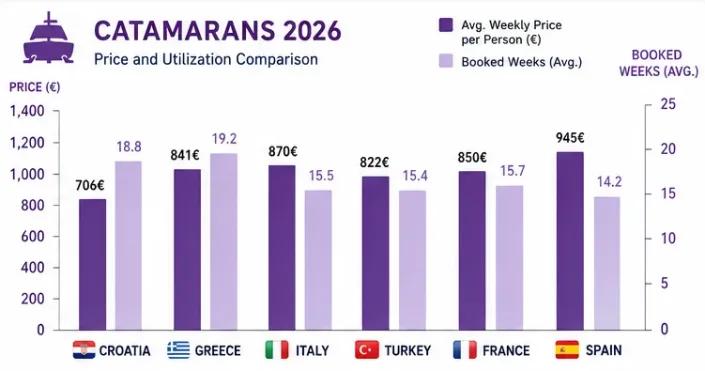
Croatian catamarans cost an average of only €706 per person per week, the lowest price in the comparison, yet achieve 18.8 booked weeks — only 0.4 weeks less than Greece.
This combination of very low prices and exceptionally high utilization is an important economic signal. It does not automatically mean that Croatian operators can raise prices without affecting demand, but it strongly suggests that pricing policy deserves reconsideration.
If boats are already being booked for close to the maximum number of commercially realistic weeks, the question arises whether maximizing occupancy should remain the primary goal — or whether part of that demand could be converted into higher prices and greater revenue.
Catamarans reveal an even stronger contrast
The catamaran market presents an even more dramatic picture.
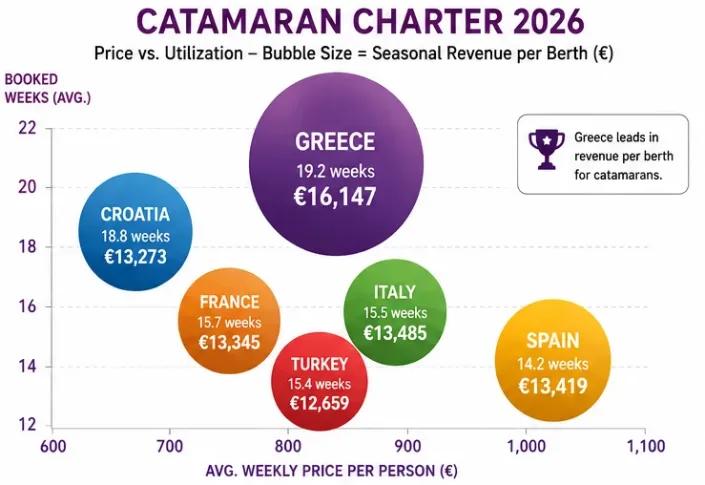
Spain has the highest average price at €945 per person per week.
That is 34% higher than Croatia's €706.
However, Spanish catamarans are booked for an average of only 14.2 weeks.
Croatia, on the other hand, achieves 18.8 weeks.
The difference is 4.6 additional booked weeks in Croatia's favor.
Despite the huge difference in utilization, the resulting seasonal revenue is surprisingly similar:
-
Spain: €13,419 per berth
-
Croatia: €13,273 per berth
In other words, Spain achieves a significantly higher price, while Croatia achieves significantly higher utilization — and the two markets ultimately reach almost the same level of gross seasonal revenue.
Catamaran charter in 2026
|
Country |
Avg. weekly price / person |
Booked weeks |
Seasonal revenue / berth |
|
★ Greece |
€841 |
19.2 ★ |
€16,147 ★ |
|
Italy |
€870 |
15.5 |
€13,485 |
|
Spain |
€945 ★ |
14.2 |
€13,419 |
|
France |
€850 |
15.7 |
€13,345 |
|
Croatia |
€706 |
18.8 |
€13,273 |
|
Turkey |
€822 |
15.4 |
€12,659 |
Greece once again comes out on top.
The average price of a Greek catamaran is €841, considerably lower than Spain's €945, but Greek catamarans are booked for 19.2 weeks, the highest figure in the comparison.
This combination produces estimated revenue of €16,147 per berth, around 20% higher than Spain, despite Spain having the highest weekly price.
The most expensive boat is not necessarily the best business
These figures reveal an important distinction between pricing power and the ability to generate revenue.
Turkey has the highest sailboat prices.
Spain has the highest catamaran prices.
Croatia has the lowest prices in both categories.
Yet Greece generates the highest estimated seasonal revenue in both segments.
The reason is simple: the ability of a charter boat to generate revenue depends both on its price and on how many weeks it is actually rented.
A weekly price of €1,000 per person means little if the boat remains unrented for a large part of the season. On the other hand, a boat that is booked almost continuously may be underpriced if its weekly rate is too low.
The cost of pursuing maximum occupancy
There is another side to exceptionally high occupancy.
Every booked week creates operational work: client check-in, check-out, cleaning, inspection, provisioning, technical preparation and maintenance. More bookings also mean greater physical use of the boat and more wear on equipment.
High occupancy also creates pressure on the destination itself. A larger number of charter boats means more vessels at anchorages, in sheltered bays and at the most popular swimming spots, which can create congestion during the peak season and significantly reduce the quality of the experience. A guest who rented a boat at a lower price may ultimately be less satisfied if overcrowded anchorages and bays prevent them from enjoying the peace and relaxation they expected.
For this reason, 100% occupancy is not necessarily the optimal economic goal.
At a certain point, it may be more profitable for a charter company to accept slightly lower occupancy in exchange for a significantly higher weekly price — especially if the additional revenue compensates for the operational workload and wear associated with another charter turnover.
That is why the combination of price × booked weeks is more informative than occupancy alone.
The Mediterranean charter market follows very different strategies
The 2026 data shows six clearly positioned markets.
Greece currently achieves the best overall economic result, combining high utilization with relatively strong prices.
Turkey has the highest sailboat prices, but does not generate the highest seasonal revenue.
Spain achieves the highest catamaran prices, but its lower utilization largely offsets that pricing advantage.
Italy occupies a relatively balanced middle position in both categories.
France achieves high sailboat utilization, but its lower average price limits gross revenue per berth.
And Croatia combines the lowest prices with exceptionally high utilization — a combination that raises the obvious question of whether its charter fleets are positioned aggressively enough in terms of pricing relative to the demand the market is demonstrating.
However, the broader lesson applies across the entire Mediterranean:
The winner in the charter market is not necessarily the country with the highest prices or the country with the most heavily booked boats. It is the market that finds the best balance between these two factors.
Methodology
The data is current for 2026 and covers the operational charter season from April 1 to November 2. The winter period, when a large part of the fleet is not in operational use, has been excluded in order to remove statistical distortions caused by boats that are typically unavailable or have only a minimal number of bookings during winter.
All prices are expressed per person/berth. The weekly charter price of each boat was divided by its maximum sleeping capacity, providing a comparable measure of charter cost per person regardless of boat size.
The average number of booked weeks shows how many weeks the average boat was rented during the analyzed operational season.
Seasonal revenue per berth is calculated by multiplying the average weekly charter price per person by the average number of booked weeks. It represents gross charter revenue only and does not include commissions, maintenance, marina costs, insurance, management, cleaning, taxes, financing or other operating expenses.
In short: the figures show where charter guests pay the most, where boats are booked the most and — most importantly — where the combination of price and utilization creates the greatest potential for gross revenue.
The data on which this analysis is based is continuously updated throughout the charter seasons, and the latest statistics, charts and downloadable datasets are available free of charge on the statistics page for journalists, researchers and industry professionals who wish to conduct their own analysis or use the data in their own reporting, provided that Yacht-Rent is credited and linked as the data source.
Author: Ani Trstenjak, PhD